1776–1976 Bicentennial Quarter Value Guide: Rare Errors, S and D Mint Marks, and How Much These Coins Are Worth Today

1776–1976 Bicentennial Quarter Value Guide: Rare Errors, S and D Mint Marks, and How Much These Coins Are Worth Today

1776–1976 Bicentennial Quarter Value Guide: The 1776–1976 Bicentennial Quarter is one of the most recognizable coins in American history. Created to celebrate the 200th anniversary of the United States, these special quarters feature a unique reverse design and a dual date, making them instantly distinguishable from regular Washington quarters. Millions of Americans have encountered these coins in pocket change, collections, and inherited coin sets, leading many to wonder whether their Bicentennial Quarter might be worth more than 25 cents.

While most Bicentennial Quarters remain common, certain examples can command impressive premiums due to mint marks, silver content, exceptional condition, and rare minting errors. Some collectors have paid hundreds or even thousands of dollars for particularly desirable specimens.

This comprehensive guide explores everything you need to know about Bicentennial Quarter values, including mint marks, error coins, grading factors, silver versions, and tips for identifying valuable examples.

History of the 1776–1976 Bicentennial Quarter

In the early 1970s, the United States prepared to celebrate its Bicentennial. To commemorate this historic occasion, the U.S. Mint introduced special designs for the quarter, half dollar, and dollar coin.

Instead of displaying a single year, Bicentennial coins feature the dual date:

1776–1976

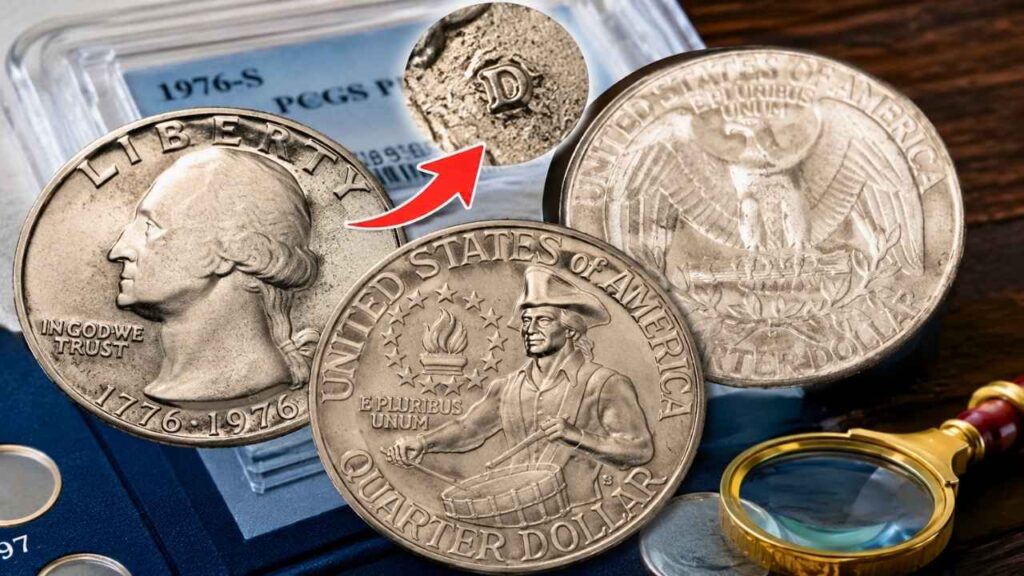
The quarter retained the familiar portrait of George Washington on the obverse while introducing a special reverse designed by Jack L. Ahr. The reverse depicts a Colonial drummer accompanied by a torch surrounded by thirteen stars representing the original colonies.

Production began in 1975 and continued through 1976. As a result, no quarters were issued bearing the date 1975.

Key Features of the Bicentennial Quarter

FeatureDescription
ObverseGeorge Washington Portrait
ReverseColonial Drummer Design
DesignerJack L. Ahr
Date1776–1976
CompositionCopper-Nickel Clad or 40% Silver
Diameter24.3 mm
Weight5.67 g (Clad)
EdgeReeded
Mint LocationsPhiladelphia, Denver, San Francisco

Understanding these characteristics helps collectors identify authentic Bicentennial Quarters and distinguish between common and valuable examples.

Why People Think Bicentennial Quarters Are Rare

Many internet stories claim that all Bicentennial Quarters are valuable. This is not accurate.

More than 1.6 billion Bicentennial Quarters were produced across multiple mints. Because of this enormous production, most circulated examples remain worth only face value.

However, several factors can increase value significantly:

  • Silver composition
  • Rare mint errors
  • High-grade condition
  • Proof strikes
  • Low-population certified examples
  • Special collector editions

These are the coins collectors actively seek.

Bicentennial Quarter Mintage Figures

The total number produced helps explain why ordinary examples are common.

MintMint MarkMintage
PhiladelphiaNone809,784,016
DenverD860,118,839
San Francisco Clad ProofS7,059,099
San Francisco Silver ProofS4,000,000+
San Francisco Silver UncirculatedS11,000,000+

With over 1.6 billion circulation strikes produced, finding a standard Bicentennial Quarter is relatively easy.

Understanding Bicentennial Quarter Mint Marks

Mint marks provide valuable information regarding where a coin was produced.

No Mint Mark (Philadelphia)

Philadelphia quarters do not display a mint mark.

Most circulated examples are worth:

ConditionValue
Circulated$0.25–$1
Uncirculated MS63$2–$5
Uncirculated MS65$10–$25
MS67 and Above$100+

Coins with exceptional luster and minimal marks command the highest premiums.

D Mint Mark (Denver)

Denver produced the largest number of Bicentennial Quarters.

Typical values include:

ConditionValue
Circulated$0.25–$1
MS63$3–$6
MS65$10–$30
MS67$150–$500+

High-grade Denver examples are surprisingly difficult to find due to heavy production and handling.

S Mint Mark (San Francisco)

San Francisco struck proof and silver collector coins.

Values vary depending on composition and condition.

TypeValue Range
Clad Proof$3–$15
Silver Proof$8–$30
Deep Cameo Proof$20–$100+
Perfect PR70$100–$1,000+

Collectors particularly value flawless certified proof examples.

Silver Bicentennial Quarters

One of the most important distinctions involves silver composition.

Most Bicentennial Quarters are copper-nickel clad.

However, special collector versions contain 40% silver.

How to Identify a Silver Bicentennial Quarter

Look for:

  • S mint mark
  • Solid silver-colored edge
  • Weight around 5.75 grams
  • Original government packaging

Silver versions generally sell for several times face value even in average condition.

Rare Bicentennial Quarter Errors

Error coins often generate the highest collector demand.

Double Die Error

A doubled die occurs when design elements appear duplicated due to die production mistakes.

Potential value:

ConditionEstimated Value
Minor Doubling$50–$150
Strong Doubling$200–$1,000+

Collectors inspect lettering, dates, and design details for evidence of doubling.

Off-Center Strike

An off-center strike occurs when the coin blank is misaligned during minting.

Value depends on:

  • Percentage off-center
  • Visibility of date
  • Overall appearance

Examples can sell for:

$50–$500+

Clipped Planchet Error

A clipped planchet results when part of the metal blank is missing before striking.

Values often range from:

$25–$300+

depending on clip size and condition.

Die Crack Error

Die cracks create raised lines on the coin’s surface.

Small cracks may add modest premiums, while dramatic examples attract strong collector interest.

Typical values:

$10–$200+

Wrong Planchet Error

Some Bicentennial Quarters were accidentally struck on planchets intended for other denominations.

These are among the most valuable errors.

Examples have sold for:

$1,000–$10,000+

depending on rarity and certification.

Key Highlights

  • Bicentennial Quarters feature the dual date 1776–1976.
  • More than 1.6 billion were produced.
  • Most circulated examples are worth only face value.
  • Silver S-mint versions carry additional collector value.
  • High-grade certified examples can be worth hundreds of dollars.
  • Rare mint errors often command the highest prices.
  • Wrong planchet and major doubled die errors are especially desirable.
  • Proof coins from San Francisco remain popular with collectors.

Final Words

The 1776–1976 Bicentennial Quarter represents an important piece of American history and remains one of the most collected modern U.S. coins. While most examples found in circulation are worth only 25 cents, certain silver issues, high-grade specimens, proof coins, and rare mint errors can be worth substantially more. Taking the time to inspect mint marks, condition, and possible error characteristics may reveal a surprisingly valuable coin hiding in an old collection or coin jar.

FAQs

Are all Bicentennial Quarters valuable?

No. Most circulated examples are worth only face value, although silver and error coins can be significantly more valuable.

How can I tell if my Bicentennial Quarter is silver?

Check for an S mint mark, a silver-colored edge without copper showing, and verify the weight.

What is the rarest Bicentennial Quarter error?

Wrong planchet errors are generally considered among the rarest and most valuable.

Why do Bicentennial Quarters have two dates?

The dual date 1776–1976 commemorates the 200th anniversary of American independence.

What does the D mint mark mean?

The D mint mark indicates the coin was struck at the Denver Mint.

What does the S mint mark mean?

The S mint mark indicates the coin was produced at the San Francisco Mint, typically as a proof or collector issue.

Can a Bicentennial Quarter be worth thousands of dollars?

Yes. Rare error coins and top-grade certified examples have sold for thousands of dollars.

Should I clean my Bicentennial Quarter?

No. Cleaning usually reduces collector value and may damage the coin’s surface.

If you want the full 4,000+ word version, I can continue with Part 2 covering advanced grading, auction records, top 20 rare errors, silver proof sets, price charts, collecting strategies, and investment potential.

Leave a Comment

Your email address will not be published. Required fields are marked *

Scroll to Top