1776–1976 Bicentennial Quarter Value Guide: Rare Errors, S & D Mint Marks Worth Money

1776–1976 Bicentennial Quarter Value Guide: Rare Errors, S & D Mint Marks Worth Money

1776–1976 Bicentennial Quarter Value Guide: The 1776–1976 Bicentennial Quarter is one of the most recognizable coins in American history. Created to celebrate the 200th anniversary of the United States, these quarters feature a unique reverse design that sets them apart from regular Washington quarters. While millions were produced and most are worth only face value, certain rare varieties, mint-state examples, silver issues, and error coins can be worth hundreds or even thousands of dollars.

Many collectors and coin enthusiasts search through old coin jars, inherited collections, and pocket change hoping to find a valuable Bicentennial Quarter. Understanding mint marks, grading, silver content, and error varieties is essential if you want to determine whether your coin is common or a hidden treasure.

This complete guide explains everything you need to know about Bicentennial Quarter values, including rare errors, S and D mint mark coins, grading factors, and tips for identifying valuable specimens.

History of the 1776–1976 Bicentennial Quarter

In 1976, the United States celebrated its Bicentennial, marking 200 years since the signing of the Declaration of Independence.

To commemorate this milestone, the U.S. Mint temporarily redesigned three circulating coins:

CoinSpecial Reverse Design
QuarterColonial Drummer Boy
Half DollarIndependence Hall
DollarLiberty Bell and Moon

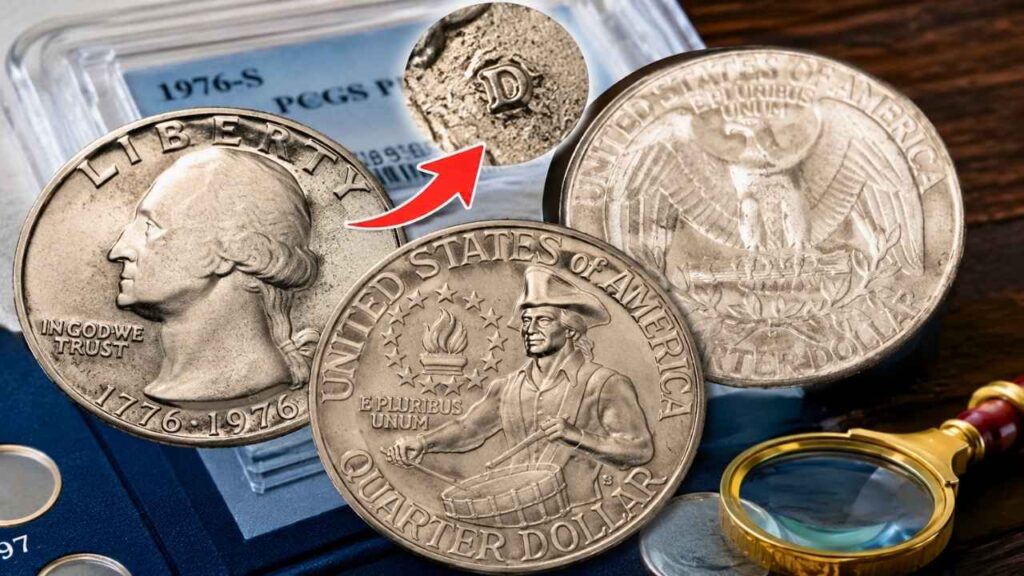
The quarter’s reverse design was created by Jack L. Ahr and features a Colonial drummer holding a torch surrounded by thirteen stars representing the original colonies.

Instead of displaying a single year, the coin bears the dual date:

1776–1976

This makes Bicentennial Quarters instantly recognizable.

Understanding Bicentennial Quarter Mint Marks

Bicentennial Quarters were produced at three U.S. Mint facilities.

Mint LocationMint MarkApproximate Mintage
PhiladelphiaNo Mint Mark809,784,016
DenverD860,118,839
San FranciscoS11,000,000+

Because over 1.6 billion circulation quarters were struck, most examples remain common today.

However, certain mint marks are considerably more desirable than others.

Philadelphia Bicentennial Quarter Value

Philadelphia coins do not carry a mint mark.

These quarters were produced in enormous numbers and are still frequently encountered.

Typical Values

GradeValue
Circulated$0.25
AU$1–$3
MS63$5–$10
MS65$15–$35
MS67$500+

Coins with strong strikes, attractive luster, and few contact marks command the highest premiums.

Denver Bicentennial Quarter Value

Denver-issued Bicentennial Quarters feature a small “D” mint mark located on the obverse near Washington’s ponytail.

Although Denver struck more quarters than Philadelphia, some high-grade examples are surprisingly scarce.

Typical D Mint Values

GradeValue
Circulated$0.25
MS63$5–$12
MS65$20–$40
MS66$75–$150
MS67$1,000+

Collectors often pay substantial premiums for exceptional Denver coins with outstanding preservation.

San Francisco Bicentennial Quarter Value

The San Francisco Mint produced two collector versions:

  1. Copper-Nickel Clad Proof
  2. 40% Silver Proof and Uncirculated Sets

These coins carry the “S” mint mark.

Typical Proof Values

TypeValue Range
Clad Proof$3–$15
Silver Proof$8–$40
Deep Cameo Silver Proof$50–$200+

High-grade silver proofs remain highly desirable among collectors.

How to Identify a Silver Bicentennial Quarter

Many collectors wonder whether their Bicentennial Quarter contains silver.

The easiest method is weighing the coin.

TypeWeight
Clad Quarter5.67 grams
40% Silver Quarter5.75 grams

You can also inspect the coin’s edge.

Clad Edge

Shows a copper-colored stripe.

Silver Edge

Appears solid silver without a visible copper band.

Silver examples are usually found in special mint sets rather than circulation.

Why Some Bicentennial Quarters Are Worth Thousands

Several factors determine value:

Grade

Higher grades dramatically increase value.

Rarity

Rare varieties attract strong collector demand.

Error Coins

Minting mistakes often command premiums.

Silver Content

Silver versions naturally carry higher values.

Eye Appeal

Beautiful toning and strong luster increase desirability.

Rare Bicentennial Quarter Errors Worth Money

Error coins are among the most exciting discoveries.

Collectors actively seek unusual production mistakes.

Double Die Errors

A doubled die occurs when the design is impressed more than once onto the die at slightly different angles.

Signs include:

  • Doubling in lettering
  • Blurred numbers
  • Distorted design elements

Value Range

ConditionValue
Minor Doubling$50–$200
Strong Doubling$300–$1,500+

Authenticity should be verified by professional grading services.

Off-Center Strike Errors

An off-center strike occurs when the blank planchet is improperly positioned during striking.

The design appears shifted away from the center.

Value Factors

  • Percentage off-center
  • Visible date
  • Overall condition

Estimated Values

Off-Center PercentageValue
5–10%$25–$75
20–40%$100–$500
50%+$500–$2,000+

Clipped Planchet Errors

Clipped planchets result when the metal blank is improperly punched.

Part of the coin is missing before striking.

Typical Values

Size of ClipValue
Small$20–$75
Medium$75–$200
Large$200–$800

Broadstrike Errors

Broadstruck coins are produced without the retaining collar.

The coin appears larger and flatter than normal.

Value Range

$50–$300 depending on condition.

Wrong Planchet Errors

One of the most valuable Bicentennial Quarter errors involves being struck on the wrong type of blank.

Examples include:

  • Dime planchets
  • Nickel planchets
  • Foreign coin blanks

Potential Values

Wrong Planchet TypeValue
Dime Planchet$500–$2,500
Nickel Planchet$1,000–$4,000
Foreign Planchet$2,000–$10,000+

These are among the rarest known Bicentennial Quarter varieties.

Missing Clad Layer Errors

A missing clad layer exposes the coin’s core metal.

The coin may appear:

  • Copper colored
  • Unusually light
  • Missing outer coating

Value Range

$100–$1,500+

Dramatic Die Cracks and Cuds

As dies wear out, cracks develop.

When a section of the die breaks away completely, a raised blob called a cud appears on the coin.

Typical Values

Error TypeValue
Minor Die Crack$20–$75
Major Die Crack$75–$300
Large Cud$300–$1,500+

Highest Auction Prices for Bicentennial Quarters

Although common examples are plentiful, exceptional coins have achieved impressive auction results.

Coin TypeGradeApproximate Value
Bicentennial QuarterMS67+$4,000+
Silver ProofPR70 Deep Cameo$1,000+
Major Error CoinVarious$5,000+
Wrong Planchet ErrorVarious$10,000+

Auction prices fluctuate according to collector demand and market conditions.

How Coin Grading Affects Value

Professional grading significantly impacts market value.

Poor (P-1)

Extremely worn.

Good (G-4)

Heavy wear but readable.

Fine (F-12)

Moderate detail remains.

Extremely Fine (XF-40)

Light wear only.

About Uncirculated (AU-50)

Nearly mint condition.

Mint State (MS-60 to MS-70)

No circulation wear.

The difference between MS65 and MS67 can mean hundreds or even thousands of dollars.

Best Places to Find Valuable Bicentennial Quarters

Many valuable examples remain undiscovered.

Popular hunting locations include:

  • Bank rolls
  • Estate sales
  • Coin shows
  • Flea markets
  • Antique stores
  • Inherited collections
  • Old piggy banks
  • Coin jars

Searching large quantities increases your chances of success.

How to Examine a Bicentennial Quarter

Use proper tools for accurate evaluation.

Recommended Equipment

ToolPurpose
Magnifying GlassSpot errors
Digital ScaleVerify weight
Coin LoupeExamine details
LED LightInspect surfaces
Coin GuideCompare varieties

Careful examination often reveals features missed by the naked eye.

Should You Clean a Bicentennial Quarter?

The answer is simple:

No.

Cleaning damages surfaces and often reduces value dramatically.

Professional collectors strongly prefer original, untouched coins.

Even a rare coin can lose substantial value after cleaning.

Tips for Selling Valuable Bicentennial Quarters

If you discover a potentially valuable example:

  1. Handle only by the edges.
  2. Place it in a protective holder.
  3. Avoid cleaning.
  4. Weigh the coin.
  5. Photograph both sides.
  6. Compare with known varieties.
  7. Consider professional grading.

Certified coins generally sell for higher prices because buyers trust the grade and authenticity.

Most Valuable Bicentennial Quarter Characteristics

Look for these traits:

  • Sharp strike
  • Strong luster
  • Minimal contact marks
  • Rare mint errors
  • Silver composition
  • Exceptional grading
  • Attractive toning
  • Proof finish

Coins possessing multiple desirable characteristics command the highest premiums.

Key Highlights

FeatureWhy It Matters
S Mint MarkIncludes collectible proof and silver versions
D Mint MarkHigh-grade examples can be valuable
Silver CompositionWorth more than standard clad coins
Error VarietiesOften worth hundreds or thousands
MS67+ GradesExtremely valuable to collectors
Wrong Planchet ErrorsAmong the rarest and most expensive
Proof CoinsPopular collector pieces
Original SurfacesEssential for maintaining value

Final Words

The 1776–1976 Bicentennial Quarter remains one of America’s most collected modern coins. While most examples are worth only twenty-five cents, rare errors, silver issues, pristine mint-state coins, and high-grade proof examples can be worth far more. Collectors continue searching for doubled dies, off-center strikes, wrong planchet errors, and premium-condition specimens that stand out from the billions produced.

If you own Bicentennial Quarters, take time to inspect them carefully. A quick examination of mint marks, weight, strike quality, and possible errors could reveal a coin worth hundreds or even thousands of dollars. Patience, knowledge, and attention to detail remain the keys to finding the next valuable Bicentennial Quarter.

FAQs

Are all 1776–1976 Bicentennial Quarters valuable?

No. Most circulated examples are worth only face value, although uncirculated, silver, and error coins can be significantly more valuable.

How do I know if my Bicentennial Quarter is silver?

Check the edge for the absence of a copper stripe and verify the weight. Silver versions generally weigh about 5.75 grams and have a solid silver-colored edge.

What is the rarest Bicentennial Quarter error?

Wrong planchet errors are among the rarest and most valuable, often selling for thousands of dollars.

Where is the mint mark located?

The mint mark appears on the obverse near Washington’s ponytail. Philadelphia coins have no mint mark.

Are Bicentennial Quarters still found in circulation?

Yes. Millions remain in circulation, making them one of the easiest commemorative U.S. coins to find.

Should I clean my Bicentennial Quarter before selling it?

No. Cleaning almost always reduces collector value and can permanently damage the coin’s surface.

What is the highest value Bicentennial Quarter ever sold?

Exceptional MS67+ examples and major mint-error coins have sold for several thousand dollars, with rare wrong-planchet specimens achieving even higher prices.

Is a D mint mark Bicentennial Quarter rare?

The D mint mark itself is not rare, but high-grade Denver examples can be surprisingly scarce and valuable.

Are S mint mark Bicentennial Quarters silver?

Not all of them. Some S mint mark quarters are clad proofs, while others were struck in 40% silver for collector sets.

How can I get my Bicentennial Quarter authenticated?

Professional grading services such as Professional Coin Grading Service and Numismatic Guaranty Company can authenticate, grade, and encapsulate valuable coins for collectors and investors.

Leave a Comment

Your email address will not be published. Required fields are marked *

Scroll to Top