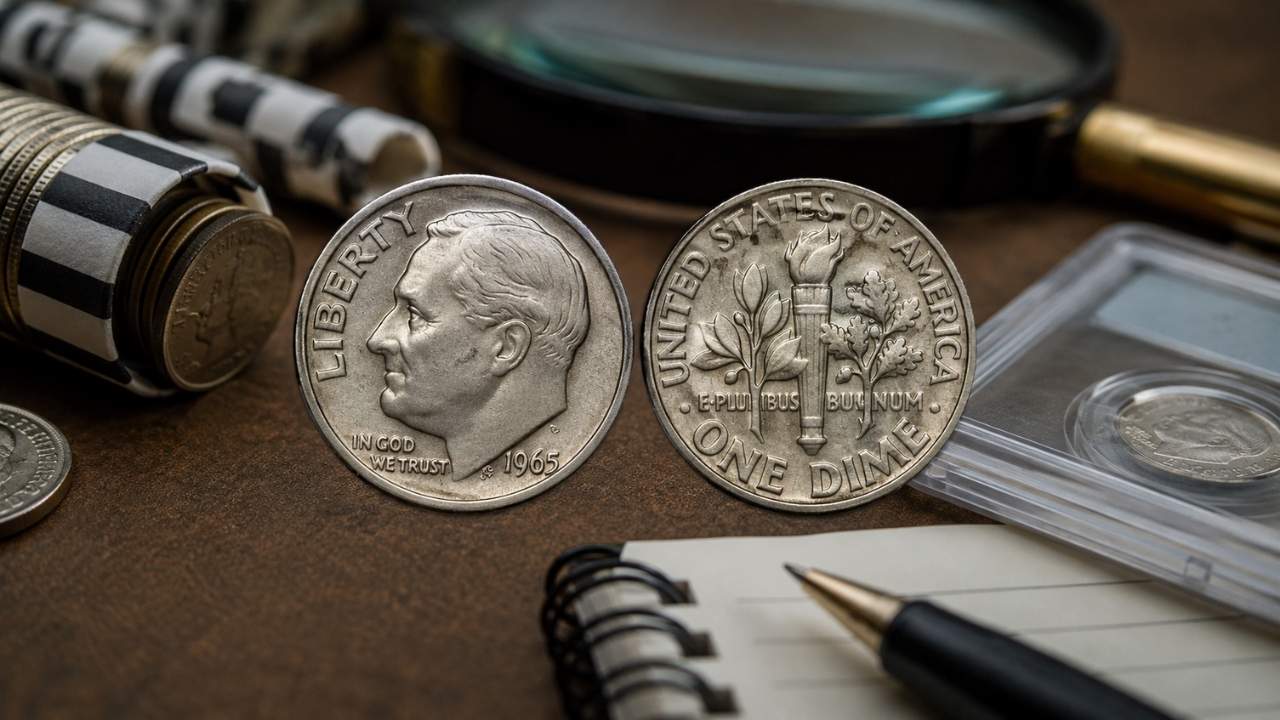
1965 Roosevelt Dime Value Guide:The 1965 Roosevelt Dime is one of the most important modern coins in United States numismatic history. While millions of Americans have handled this coin, few realize that some examples are worth far more than their ten-cent face value. Certain 1965 dimes have sold for hundreds or even thousands of dollars due to their condition, rarity, Special Mint Set status, or unusual mint errors.
For collectors, the year 1965 marks a major turning point in American coinage. It was the first year the Roosevelt Dime was struck without silver content for general circulation. It was also a year when mint marks disappeared from U.S. coins, creating a unique collecting challenge that continues today.
Whether you found a 1965 dime in pocket change, inherited a collection, or are actively searching for valuable coins, understanding what makes these dimes special can help you identify hidden treasures. This guide explores no mint mark dimes, SMS coins, valuable error varieties, grading considerations, and current market values.
The History Behind the 1965 Roosevelt Dime
The Roosevelt Dime was first introduced in 1946 following the death of President Franklin D. Roosevelt. Designed by Chief Engraver John R. Sinnock, the coin honored Roosevelt’s leadership during difficult times and his connection to the March of Dimes campaign.
By the early 1960s, silver prices began rising rapidly. Americans started hoarding silver coins, fearing their metal value would exceed their face value. This caused a nationwide coin shortage.
To solve the problem, Congress passed the Coinage Act of 1965. The legislation eliminated silver from dimes and quarters and reduced silver content in half dollars.
As a result, the 1965 Roosevelt Dime became the first regular-issue Roosevelt Dime produced using a copper-nickel clad composition instead of 90% silver.
Specifications of the 1965 Roosevelt Dime
| Feature | Specification |
|---|---|
| Denomination | Dime |
| Face Value | $0.10 |
| Year | 1965 |
| Composition | Copper-Nickel Clad |
| Weight | 2.27 grams |
| Diameter | 17.9 mm |
| Edge | Reeded |
| Designer | John R. Sinnock |
| Mint Mark | None |
| Mintage | 1,819,717,540 |
The massive production numbers mean most circulated examples remain common today.
Why the 1965 Dime Has No Mint Mark
One of the most frequently asked questions about the 1965 Roosevelt Dime concerns the missing mint mark.
Between 1965 and 1967, the United States Mint intentionally removed mint marks from circulating coins. Officials believed coin collectors were contributing to coin shortages by saving specific mint-mark varieties.
To discourage hoarding, all dimes, quarters, nickels, pennies, and half dollars struck during these years were produced without mint marks.
Although coins were manufactured at multiple facilities, no mint identification appears on the coin.
This makes the 1965 dime unique compared to many earlier and later Roosevelt Dimes.
Understanding the Clad Composition
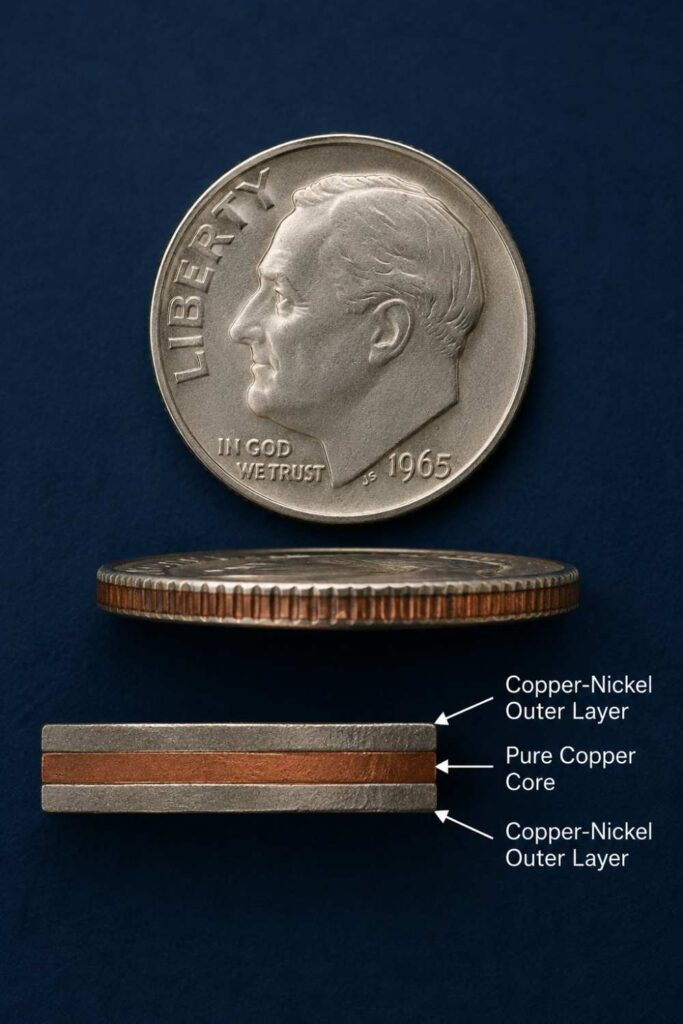
Prior to 1965, Roosevelt Dimes contained 90% silver.
Beginning in 1965, the Mint adopted a sandwich-style metal composition consisting of:
- Outer layers of copper-nickel alloy
- Pure copper center core
Collectors can easily identify clad dimes by looking at the edge. A reddish copper stripe is usually visible between the outer layers.
This composition remains standard for modern U.S. dimes today.
Obverse Design Details
The front of the coin features a left-facing portrait of President Franklin D. Roosevelt.
Important inscriptions include:
- LIBERTY
- IN GOD WE TRUST
- 1965
The initials “JS” of designer John Sinnock appear near Roosevelt’s neck truncation.
The portrait remains one of the most recognizable designs in modern American coinage.
Reverse Design Details
The reverse showcases three important symbols:
- Torch representing liberty
- Olive branch representing peace
- Oak branch representing strength
Additional inscriptions include:
- UNITED STATES OF AMERICA
- E PLURIBUS UNUM
- ONE DIME
The balanced design has remained largely unchanged since its introduction.
Current Value of a 1965 Roosevelt Dime
Most circulated examples remain worth face value because of the enormous mintage.
However, condition significantly impacts value.
Circulated Coin Values
| Grade | Estimated Value |
| Good | $0.10 |
| Very Good | $0.10 |
| Fine | $0.10 |
| Very Fine | $0.15 |
| Extremely Fine | $0.25 |
| About Uncirculated | $1 to $3 |
Mint State Coin Values
| Grade | Estimated Value |
| MS63 | $5 to $10 |
| MS64 | $8 to $15 |
| MS65 | $15 to $30 |
| MS66 | $30 to $80 |
| MS67 | $100 to $300 |
| MS68 | $1,000+ |
Top-grade examples become increasingly scarce and valuable.
Why High-Grade Coins Bring Premium Prices
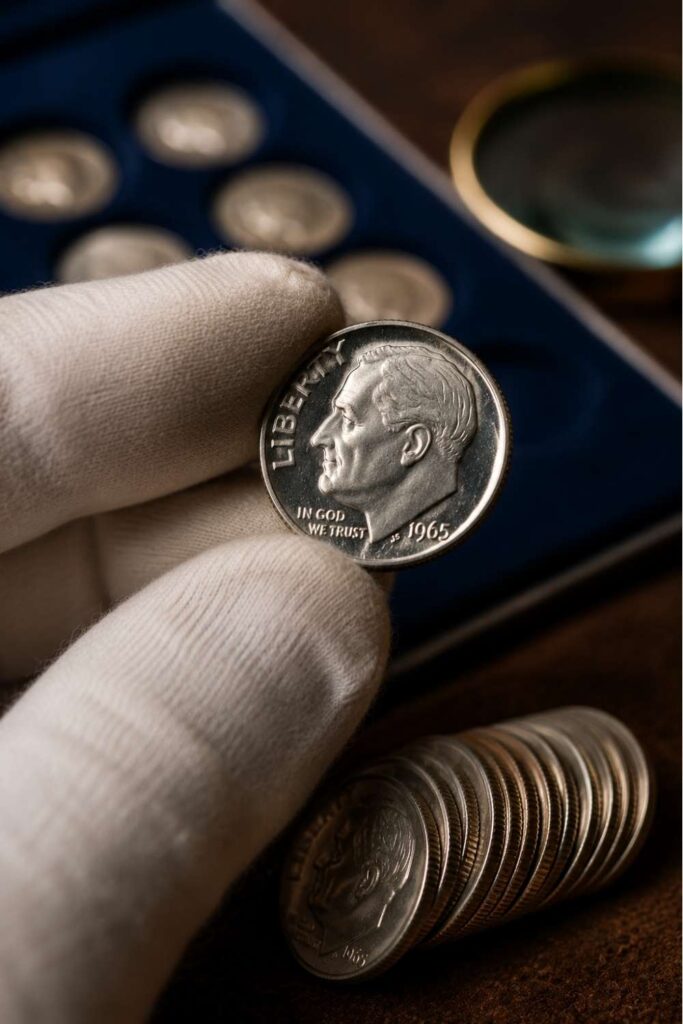
Although billions of dimes were struck, few survived in pristine condition.
Collectors seek coins with:
- Full mint luster
- Sharp strike quality
- Minimal contact marks
- Attractive eye appeal
- Original surfaces
Coins meeting these standards often command substantial premiums.
What Are Special Mint Set Coins?
From 1965 through 1967, the Mint suspended traditional proof sets.
Instead, collectors could purchase Special Mint Sets, commonly called SMS sets.
These coins were specially struck using improved production techniques.
SMS coins generally display:
- Sharper details
- Cleaner surfaces
- Enhanced luster
- Better preservation
They occupy a unique position between circulation strikes and proof coins.
1965 SMS Roosevelt Dime Values
SMS dimes are considerably more desirable than ordinary circulation examples.
| SMS Grade | Value Range |
| SMS63 | $3 to $10 |
| SMS65 | $10 to $25 |
| SMS67 | $40 to $150 |
| SMS68 | $200 to $800 |
| SMS69 | $1,000 to $5,000+ |
The finest known specimens can achieve impressive auction results.
Full Torch Designation
Many advanced collectors pursue Full Torch examples.
A Full Torch designation indicates complete strike detail on the torch bands located on the reverse.
This characteristic suggests:
- Superior strike quality
- Better die condition
- Enhanced collector appeal
Full Torch specimens often sell for significantly more than ordinary examples in similar grades.
Rare 1965 Roosevelt Dime Errors
Error coins represent some of the most exciting discoveries in coin collecting.
Several notable error varieties exist for the 1965 Roosevelt Dime.
Doubled Die Errors
Doubled dies occur when a die receives multiple impressions during production.
Visible doubling may appear on:
- Date
- LIBERTY
- IN GOD WE TRUST
Strong doubled dies can be worth hundreds of dollars.
Off-Center Strikes
An off-center strike occurs when the planchet is misaligned during striking.
The resulting design appears shifted away from the center.
| Off-Center Amount | Value Range |
| 5% | $10 to $30 |
| 10% | $25 to $75 |
| 20% | $75 to $250 |
| 50% | $250 to $1,000+ |
Coins retaining a visible date are usually the most valuable.
Clipped Planchet Errors
A clipped planchet results when part of the metal blank is missing before striking.
These clips can appear as:
- Curved clips
- Straight clips
- Irregular clips
Values generally range from $20 to several hundred dollars.
Broadstrike Errors
Broadstrikes occur when a coin is struck without the retaining collar.
The coin expands beyond normal dimensions while maintaining design details.
Depending on condition, broadstrikes often sell for:
| Grade | Estimated Value |
| Circulated | $20 to $75 |
| Uncirculated | $75 to $250 |
| Exceptional Examples | $300+ |
Die Crack Errors
Over time, dies develop cracks due to repeated use.
These cracks transfer onto coins as raised lines.
Minor die cracks may bring modest premiums, while dramatic examples attract strong collector demand.
Die Break and Cud Errors
When part of a die breaks away completely, a cud error can occur.
Large raised areas of metal appear on the coin.
Values depend on:
- Size
- Location
- Visual appeal
- Condition
Major cud errors often sell between $50 and $500.
Wrong Planchet Errors
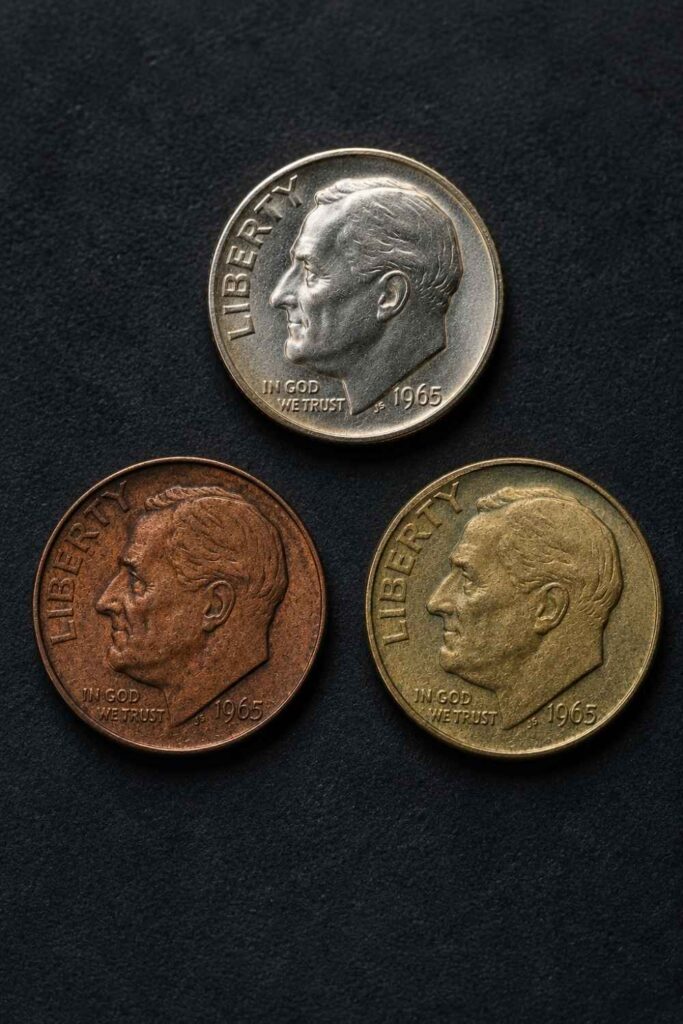
Wrong planchet errors occur when a dime design is struck on metal intended for another denomination.
Examples may include:
- Penny planchets
- Foreign coin blanks
- Experimental blanks
These errors are highly collectible and often worth several hundred or thousands of dollars.
Silver Planchet Errors
One of the most valuable 1965 dime errors involves silver planchets.
Because the Mint transitioned from silver to clad coinage, a few leftover silver blanks may have entered production accidentally.
Characteristics include:
- No copper edge stripe
- Slightly different weight
- Distinct silver appearance
Authenticated examples have sold for thousands of dollars at auction.
How to Identify a Valuable 1965 Dime
Collectors should examine several factors:
Check the Edge
A normal clad dime displays a copper-colored stripe.
Absence of the stripe may indicate a silver planchet error.
Look for Exceptional Condition
Coins with strong luster and minimal wear are worth more.
Search for Errors
Inspect the coin under magnification for:
- Doubling
- Clipping
- Off-center strikes
- Die cracks
- Cuds
Evaluate Strike Quality
Sharp details often indicate higher collector demand.
Record Auction Prices
Exceptional 1965 Roosevelt Dimes have produced remarkable auction results.
Certified high-grade examples and elite SMS specimens regularly achieve premium prices.
| Coin Type | Auction Range |
| MS67 Business Strike | $200 to $500 |
| MS68 Business Strike | $1,000+ |
| SMS68 | $500 to $2,000 |
| SMS69 | Several Thousand Dollars |
| Rare Error Coins | Hundreds to Thousands |
Market conditions and collector demand continue influencing these values.
Should You Get Your 1965 Dime Graded?
Professional grading may be worthwhile if your coin:
- Appears uncirculated
- Shows a possible error
- Lacks a copper edge stripe
- Displays exceptional eye appeal
Certification can increase buyer confidence and improve resale value.
Investment Potential of the 1965 Roosevelt Dime
Most circulated examples are unlikely to generate significant investment returns.
However, certain categories remain highly desirable:
- High-grade business strikes
- Full Torch specimens
- Rare mint errors
- SMS coins
- Silver planchet errors
These varieties continue attracting collector interest.
Tips for Collectors
If you’re searching for valuable 1965 dimes:
- Examine inherited collections
- Check coin rolls from banks
- Search estate sales
- Inspect old mint sets
- Use magnification when looking for errors
Patience often rewards collectors who carefully study each coin.
Key Highlights
- 1965 was the first year Roosevelt Dimes were struck without silver for circulation.
- No mint marks were used on dimes from 1965 through 1967.
- Over 1.8 billion examples were produced.
- SMS dimes are more desirable than ordinary circulation strikes.
- High-grade coins can be worth hundreds or thousands of dollars.
- Full Torch examples carry premium values.
- Silver planchet errors are among the rarest and most valuable varieties.
- Error coins such as doubled dies and off-center strikes attract strong collector demand.
- Professional grading may significantly increase marketability.
- Exceptional examples continue setting impressive auction records.
Final Words
The 1965 Roosevelt Dime represents far more than a simple ten-cent coin. It marks a historic transition in American coinage, ending the long tradition of silver dimes and introducing the clad composition still used today. While most examples remain common, high-grade specimens, Special Mint Set coins, and rare mint errors can command surprisingly high prices.
Collectors who understand what to look for may uncover valuable pieces hiding in old collections, coin albums, or even everyday pocket change. Whether you’re a beginner or an experienced numismatist, the 1965 Roosevelt Dime remains one of the most fascinating modern coins to study and collect.
FAQs
Is a 1965 Roosevelt Dime made of silver?
No. Regular circulation dimes from 1965 were made from copper-nickel clad metal. However, rare silver planchet errors exist.
Why does the 1965 dime have no mint mark?
The U.S. Mint removed mint marks from 1965 to 1967 to discourage coin hoarding.
What is the value of a circulated 1965 dime?
Most circulated examples are worth face value or slightly above.
What is an SMS dime?
SMS stands for Special Mint Set, a collector issue produced from 1965 through 1967.
Are SMS dimes rare?
They are not extremely rare, but high-grade examples are highly collectible.
What is a Full Torch dime?
A Full Torch designation indicates complete strike detail on the reverse torch bands.
How can I tell if my dime is silver?
Check the edge. Silver coins lack the visible copper stripe found on clad dimes.
What is the rarest 1965 dime error?
Silver planchet errors are among the rarest and most valuable.
Can a 1965 dime be worth thousands of dollars?
Yes. High-grade SMS coins and major mint errors can sell for thousands.
Should I clean my 1965 dime?
No. Cleaning generally reduces collector value.
What grading service should I use?
Major grading services include PCGS and NGC.
Are doubled die dimes valuable?
Yes. Strong examples can be worth hundreds of dollars or more.
What causes off-center strikes?
They occur when the coin blank is misaligned during striking.
Are clipped planchet errors collectible?
Yes. Collectors actively seek clipped planchet errors.
Where can I sell a valuable 1965 dime?
You can sell through coin dealers, auctions, online marketplaces, or major numismatic auction houses.