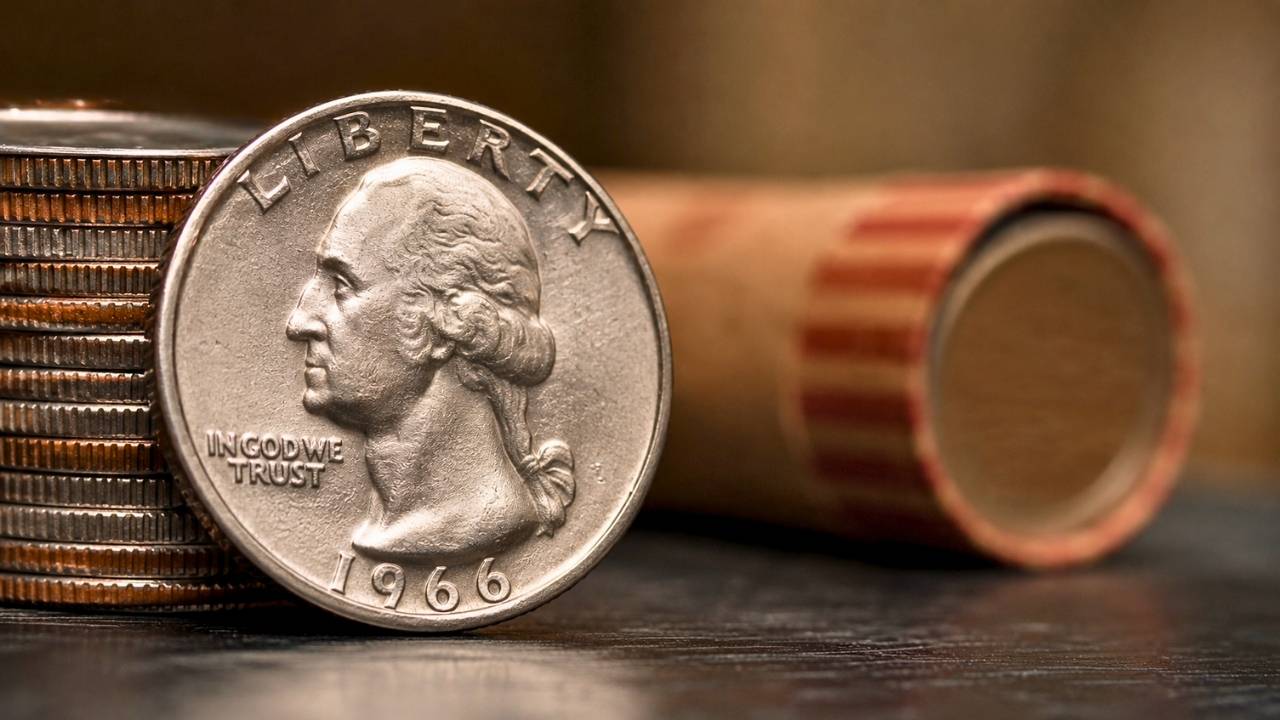
1966 Washington Quarter Value Guide: The 1966 Washington Quarter is one of the most interesting coins from the modern U.S. coinage era. While millions of these quarters were produced, certain examples have become highly desirable among collectors due to their condition, Special Mint Set (SMS) origin, and valuable mint errors. Many people still come across 1966 quarters in old collections, inherited coin albums, bank rolls, and pocket change, often wondering whether they might own a hidden treasure.
Unlike earlier Washington quarters that were struck in 90% silver, the 1966 quarter belongs to a transitional period in American coinage. Rising silver prices forced the United States Mint to eliminate silver from circulating quarters beginning in 1965. As a result, the 1966 quarter was produced using a copper-nickel clad composition instead of precious metal.
Although regular circulation examples are generally common, some rare varieties and exceptional-condition pieces have sold for hundreds or even thousands of dollars. Collectors actively seek Special Mint Set examples, doubled die reverse errors, off-center strikes, and high-grade coins certified by leading grading companies.
This guide explores everything you need to know about the 1966 Washington Quarter, including its history, specifications, value ranges, SMS coins, DDR errors, rare mint mistakes, grading factors, and the most valuable examples ever sold.
History of the 1966 Washington Quarter
The Washington Quarter series first appeared in 1932 to commemorate the 200th anniversary of George Washington’s birth. Designed by sculptor John Flanagan, the coin quickly became a permanent part of American circulation.
During the early 1960s, silver prices rose dramatically. Americans began hoarding silver coins because the metal content was becoming worth more than the face value. This led to a severe coin shortage across the country.
To address the issue, Congress passed the Coinage Act of 1965. The law removed silver from dimes and quarters while reducing silver content in half dollars. As a result, the 1966 quarter was struck using a copper core with outer layers of copper-nickel alloy.
Another unusual feature of the 1965–1967 coinage period was the temporary removal of mint marks. The U.S. Mint believed collectors were hoarding coins from certain mints, contributing to shortages. Therefore, no mint marks appeared on 1966 quarters regardless of where they were produced.
Today, the 1966 Washington Quarter represents an important chapter in U.S. coin history because it marks the nation’s transition from silver coinage to modern clad coinage.
1966 Washington Quarter Specifications
| Specification | Details |
|---|---|
| Country | United States |
| Denomination | Quarter Dollar |
| Year | 1966 |
| Series | Washington Quarter |
| Composition | Copper-Nickel Clad |
| Copper Content | 91.67% |
| Nickel Content | 8.33% |
| Weight | 5.67 grams |
| Diameter | 24.3 mm |
| Edge | Reeded |
| Designer | John Flanagan |
| Mint Mark | None |
| Obverse | George Washington |
| Reverse | Eagle with arrows and olive branches |
Understanding these specifications helps collectors identify genuine coins and distinguish valuable varieties from ordinary examples.
Why the 1966 Quarter Has No Mint Mark
One of the most frequently asked questions about the 1966 quarter is why it lacks a mint mark.
From 1965 through 1967, the U.S. Mint intentionally removed mint marks from circulating coins. Officials believed collectors were saving coins from specific mints, creating an artificial shortage in circulation.
As a result, all genuine 1966 Washington quarters were struck without mint marks. If you see a 1966 quarter with a mint mark, it may have been altered after leaving the Mint.
Because no mint marks exist, collectors determine value based on condition, strike quality, errors, and SMS designation rather than mint location.
How Many 1966 Quarters Were Made?
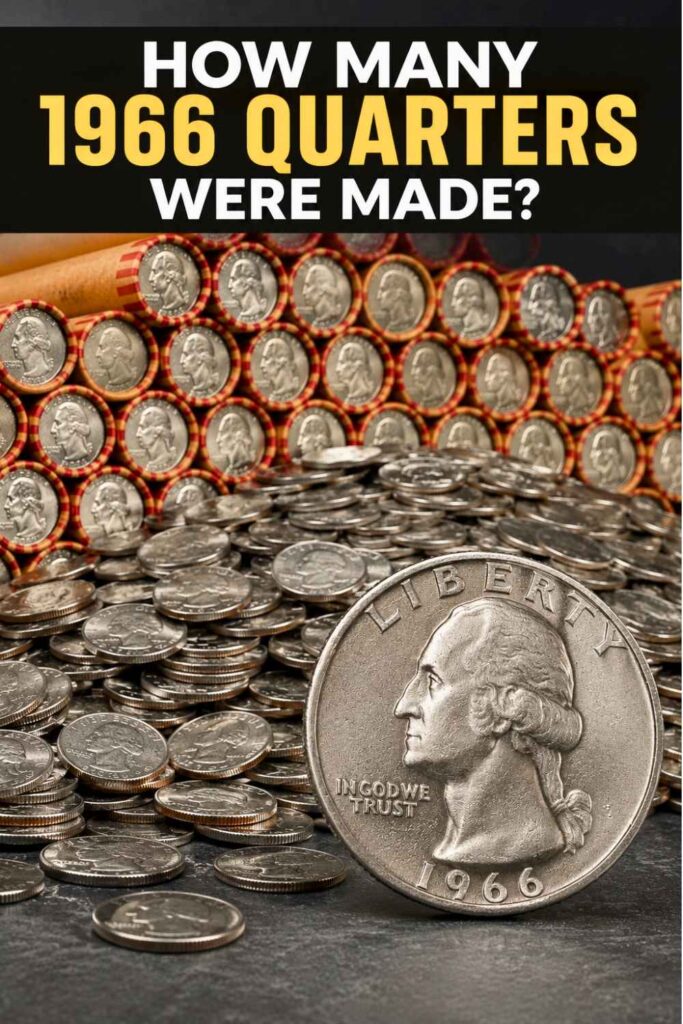
The United States Mint produced an enormous number of quarters in 1966.
| Coin Type | Mintage |
|---|---|
| 1966 Washington Quarter | 821,101,500 |
| 1966 SMS Quarter | 2,261,583 |
With more than 821 million circulation strikes produced, regular 1966 quarters are extremely common. However, the much smaller SMS production makes those coins significantly more collectible.
Understanding the 1966 SMS Quarter
The Special Mint Set quarter is often the most valuable standard version of the 1966 Washington Quarter.
During 1965–1967, the U.S. Mint suspended traditional proof coin production. Instead, collectors could purchase Special Mint Sets containing specially prepared coins.
SMS quarters display:
- Sharper strikes
- Better surface quality
- Enhanced detail
- Attractive satin-like finish
- Fewer marks than circulation strikes
Although SMS coins are not technically proof coins, they are superior in appearance and preservation compared to standard circulation examples.
Collectors pay significant premiums for high-grade SMS quarters because finding flawless examples is extremely difficult.
1966 Quarter Value Chart
| Grade | Regular Strike Value | SMS Value |
|---|---|---|
| Good (G-4) | Face Value | N/A |
| Fine (F-12) | Face Value | N/A |
| Extremely Fine (EF-40) | $0.30–$1 | N/A |
| About Uncirculated (AU-50) | $1–$3 | N/A |
| MS63 | $4–$10 | $5–$15 |
| MS65 | $15–$40 | $15–$50 |
| MS66 | $40–$150 | $50–$250 |
| MS67 | $300–$2,000+ | $500–$5,000+ |
Values can vary depending on market demand, eye appeal, and certification.
What Makes a 1966 Quarter Valuable?
Several factors influence the value of a 1966 quarter.
Condition
The better the preservation, the higher the value. Coins with little or no wear attract stronger prices.
Strike Quality
Well-struck examples show sharper details on Washington’s hair and the eagle’s feathers.
Surface Preservation
Coins free from scratches, marks, and discoloration receive higher grades.
Rarity
Error coins and rare varieties command significant premiums.
Certification
Professional grading from major services often increases market confidence and value.
1966 Doubled Die Reverse (DDR) Quarter
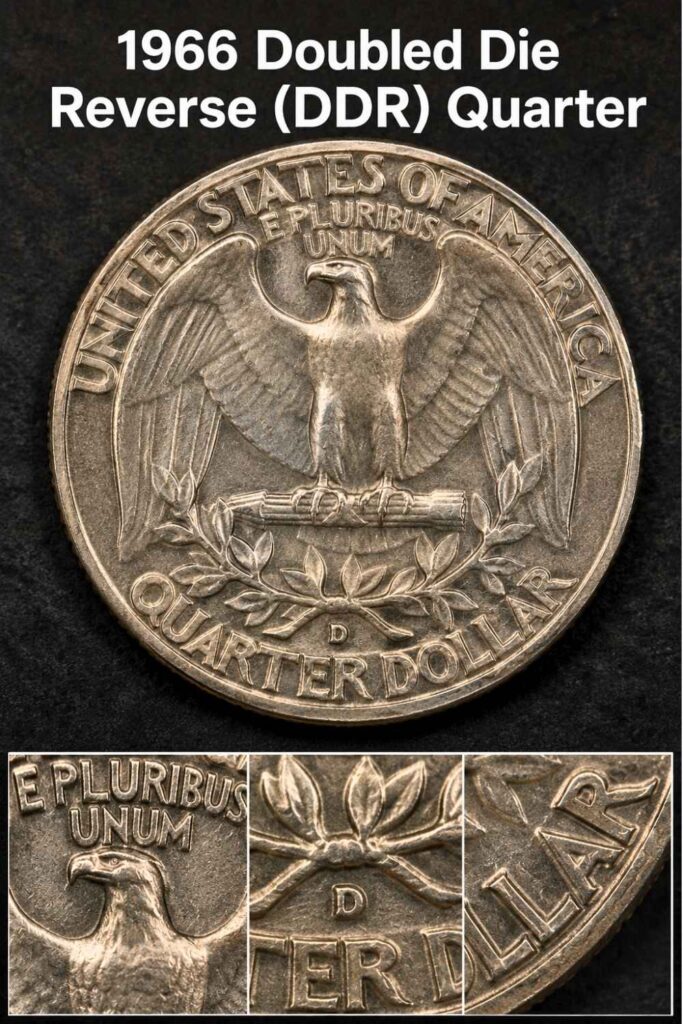
Among the most sought-after varieties is the 1966 Doubled Die Reverse quarter.
A doubled die occurs when the die receives multiple impressions during manufacturing that do not align perfectly. This creates visible doubling on parts of the design.
Collectors should inspect:
- Lettering on the reverse
- Eagle details
- Motto inscriptions
- Peripheral lettering
Strong DDR examples are significantly scarcer than normal quarters.
DDR Value Estimates
| Grade | Estimated Value |
|---|---|
| VF–XF | $25–$75 |
| AU | $75–$150 |
| MS63 | $150–$300 |
| MS65+ | $300–$1,000+ |
The strength of doubling greatly affects value.
Rare 1966 Quarter Errors Worth Money
Mint errors are among the most exciting discoveries for collectors.
Off-Center Strike Error
An off-center strike occurs when the blank coin is not properly positioned during striking.
| Off-Center Percentage | Value Range |
|---|---|
| 5%–10% | $20–$50 |
| 20%–40% | $50–$250 |
| 50%+ with Date Visible | $250–$1,000+ |
The more dramatic the error, the more valuable the coin.
Double Strike Error
A double-struck quarter receives more than one strike from the dies.
Depending on visibility and severity, values can range from $100 to several thousand dollars.
Clipped Planchet Error
A clipped planchet occurs when part of the coin blank is missing before striking.
Typical values range between $20 and $200.
Broadstrike Error
Broadstruck quarters are struck without the retaining collar.
Most examples sell for $25 to $150.
Die Crack Error
Die cracks occur when damaged dies transfer raised lines onto the coin.
Minor examples may sell for $5 to $20, while dramatic cracks can command much higher prices.
Lamination Error
Lamination flaws result from impurities in the metal.
Depending on size and appearance, values range from $20 to several hundred dollars.
Most Valuable 1966 Quarters Ever Sold
Several exceptional examples have achieved remarkable auction results.
| Coin Type | Grade | Sale Price |
|---|---|---|
| 1966 SMS Quarter | SP68 | $5,000+ |
| 1966 SMS Cameo Quarter | SP68 CAM | $8,000+ |
| 1966 DDR Quarter | High Grade | $1,000+ |
| Major Double Strike Error | Mint State | Several Thousand Dollars |
| Exceptional MS67 Quarter | Certified | $2,000+ |
These results demonstrate how condition and rarity dramatically affect value.
How to Identify a Valuable 1966 Quarter
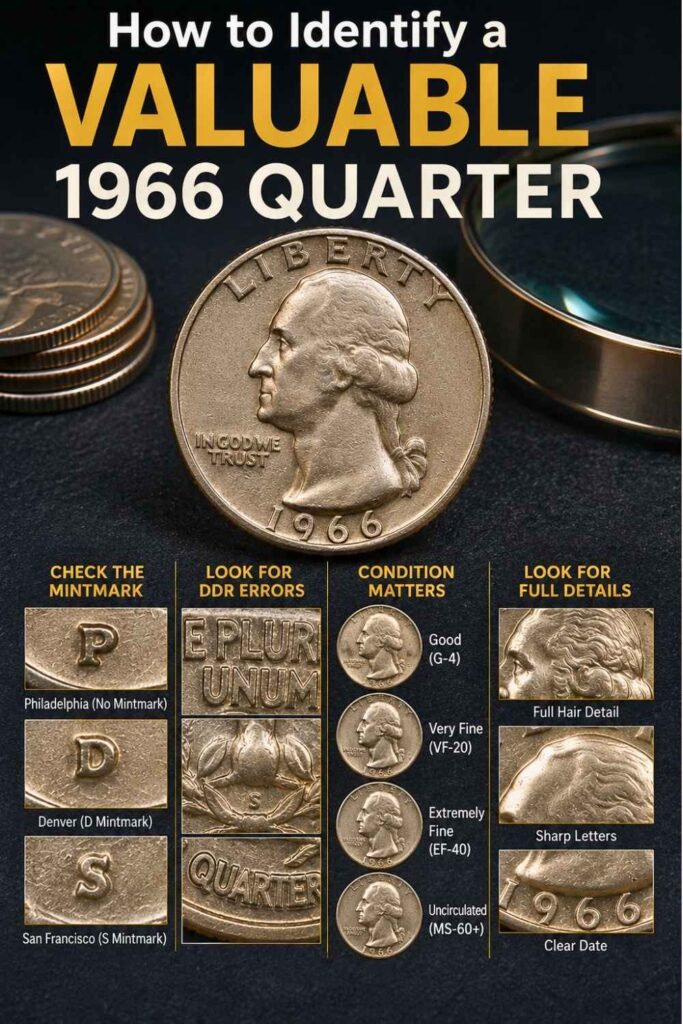
Collectors should follow a systematic approach when examining coins.
Step 1: Check the Date
Confirm the coin is dated 1966.
Step 2: Inspect the Condition
Look for:
- Strong luster
- Minimal wear
- Few contact marks
- Sharp details
Step 3: Search for Errors
Use magnification to inspect:
- Lettering
- Numbers
- Edge alignment
- Strike quality
Step 4: Compare With Known Varieties
Research recognized error types and doubled dies.
Step 5: Consider Professional Grading
Rare or high-grade examples may justify certification.
Difference Between Regular and SMS 1966 Quarters
| Feature | Regular Strike | SMS Quarter |
|---|---|---|
| Production Method | Circulation | Special Mint Set |
| Surface Quality | Standard | Satin Finish |
| Strike Sharpness | Average | Enhanced |
| Collector Demand | Moderate | High |
| Potential Value | Lower | Higher |
SMS coins generally outperform circulation strikes in the marketplace.
Grading the 1966 Quarter
Good (G)
Heavy wear with major design elements visible.
Fine (F)
Moderate wear but stronger details remain.
Extremely Fine (XF)
Light wear with most design details intact.
About Uncirculated (AU)
Only slight friction on the highest points.
Mint State (MS)
No circulation wear.
Special Mint State (SP)
Reserved for SMS coins with superior surfaces and strike quality.
High grades such as MS67 and SP68 can dramatically increase value.
Common Mistakes Collectors Make
Many collectors mistakenly assume every old quarter is valuable.
Common mistakes include:
- Ignoring condition
- Misidentifying machine doubling as DDR
- Cleaning coins
- Overestimating circulated examples
- Failing to authenticate rare errors
Avoiding these mistakes can preserve a coin’s value.
Should You Get a 1966 Quarter Professionally Graded?
Professional grading may be worthwhile if your coin:
- Appears uncirculated
- Has a strong DDR error
- Shows a significant mint error
- Looks like an exceptional SMS specimen
- Could achieve MS67 or higher
Lower-grade circulation coins generally do not justify grading costs.
Investment Potential of the 1966 Quarter
Most ordinary 1966 quarters are unlikely to become highly valuable because of their enormous mintage.
However, the following categories have shown stronger long-term demand:
- High-grade SMS examples
- Top-population certified coins
- Dramatic mint errors
- Doubled die varieties
- Attractive cameo SMS coins
Collectors continue to compete for the finest known examples.
Key Highlights
- The 1966 Washington Quarter was produced without a mint mark.
- It contains copper-nickel clad composition rather than silver.
- More than 821 million circulation quarters were minted.
- Special Mint Set quarters are generally more valuable than regular strikes.
- DDR varieties can command significant premiums.
- Major mint errors often sell for hundreds or even thousands of dollars.
- High-grade certified examples are the most sought-after by collectors.
- SMS quarters with cameo surfaces can achieve impressive auction prices.
- Condition remains the single most important factor affecting value.
- Professional grading may increase marketability for exceptional examples.
Final Words
The 1966 Washington Quarter occupies a unique place in American numismatic history. Produced during the nation’s transition away from silver coinage, it reflects a major economic and historical shift in U.S. currency. While most examples remain common and worth only modest premiums above face value, collectors continue to pursue rare SMS coins, doubled die varieties, and dramatic mint errors.
If you own a 1966 quarter, take time to inspect it carefully. A coin that initially appears ordinary could possess valuable characteristics such as a DDR variety, an off-center strike, or exceptional mint-state preservation. High-grade certified examples and rare SMS specimens remain among the most desirable modern Washington quarters and can be worth hundreds or even thousands of dollars.
For collectors, the thrill lies in the possibility that a simple quarter found in an old coin jar or inherited collection could turn out to be a valuable numismatic treasure.
FAQs
Is a 1966 quarter made of silver?
No. The 1966 Washington Quarter is made from a copper-nickel clad composition and contains no silver.
Why does my 1966 quarter have no mint mark?
The U.S. Mint removed mint marks from all coins struck between 1965 and 1967 to discourage coin hoarding.
What is a 1966 SMS quarter?
An SMS quarter is a Special Mint Set coin produced specifically for collectors with superior strike quality and surface finish.
How much is a regular 1966 quarter worth?
Most circulated examples are worth between face value and a few dollars, depending on condition.
What is the most valuable 1966 quarter?
Exceptional SMS quarters graded SP68 or higher, as well as rare error coins, can be worth several thousand dollars.
What is a DDR error on a 1966 quarter?
DDR stands for Doubled Die Reverse, a minting variety that creates visible doubling on the reverse design.
Are 1966 error quarters rare?
Yes. Significant mint errors such as off-center strikes, double strikes, and doubled dies are much scarcer than normal quarters.
Should I clean my 1966 quarter?
No. Cleaning almost always reduces collector value and can damage the coin’s surfaces.
How can I tell if my 1966 quarter is valuable?
Check for mint-state condition, SMS characteristics, doubled die features, and major mint errors.
Is it worth grading a 1966 quarter?
Grading may be worthwhile for high-grade, rare-error, or exceptional SMS examples that could command significant premiums.